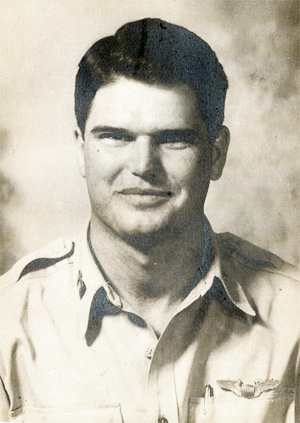
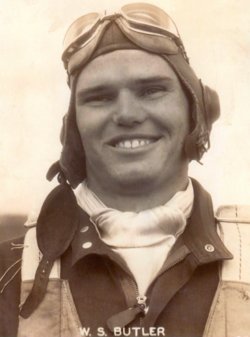
Walter Sidney Butler, Jr was born on September 23, 1920 in Huntingdon, Tennessee. He graduated Huntingdon High School in 1938 and he then completed two years at Memphis State. In April of 1941, he joined the Air Force and became a pilot. “Lucky” was his nickname.
While in China, he served under General Chenault and was a member of the Flying Tigers in China. Walter S. Butler was continuously flying during WWII and was decorated after two years. During the war, he was sent back to America and was stationed in Texas. He was sent back to Americal for his own safety. He did, however, return to Burma and was serving in Burma when his plane was shot down on April 3, 1945. He had achieved the promotion to major two days before he had been shot down. It was a very dense jungle with thick fog where his plane went down and nothing was ever found. After October, he was officially pronounced dead.
From the site American War Memorials Overseas, Inc at uswarmemorials.org, it states:
Major Walter S Butler, Jr was leading a dive bombing and strafing mission in P-51D #44-11284 3 April 1945 on a course of 130 degrees. The visibility was four miles in haze. He and his wing aircraft had left a base at Laohwangping with a target at Yangtong. His plane was hit by anti-aircraft fire on their last pass approximately one-half mile east of Erh Tong [ie Erh-Tong Airfield at Kweilin], headed west.
His wingman, 2nd Lt Harry Hill, Jr, ASN O-705582, stated the following, “Butler was leading the flight. I was flying Butler’s wing. Butler called the flight and said that this was our last pass. I saw Butler heading west as I was making my pass in a SW direction. I pulled up from my pass and started rendezvous, calling Butler and asking his position. The last thing I heard, Butler called ‘I am hit.’ The remainder of the flight tried to call Butler but no radio contact was made. We rendezvous, searched for his plane or parachute and sighted neither, it is believed he possibly went into the cloud layer and headed north.”
Major Butler was declared dead 3 October 1945 but still missing. His name is commemorated on the Walls of the Missing, Manila American Cemetery, Taguig City, Philippines. He was one of over 2000 Americans who lost their lives defending China from their Japanese invaders from 1941-1945. He is also commemorated on the The Monument to the Aviation Martyrs in the War of Resistance Against Japan in Nanjing, China. His family honors his memory with a monument Major Walter Sidney Butler, Jr – Family Plot in Liberty All Cemetery, Huntingdon TN.
He was flying with the 76th Fighter Squadron, 23rd Fighter Group.
Notable medals include the Distinguished Flying Cross with Oak Leaf Cluster, Air Medal with Oak Leaf Cluster, and the Purple Heart.
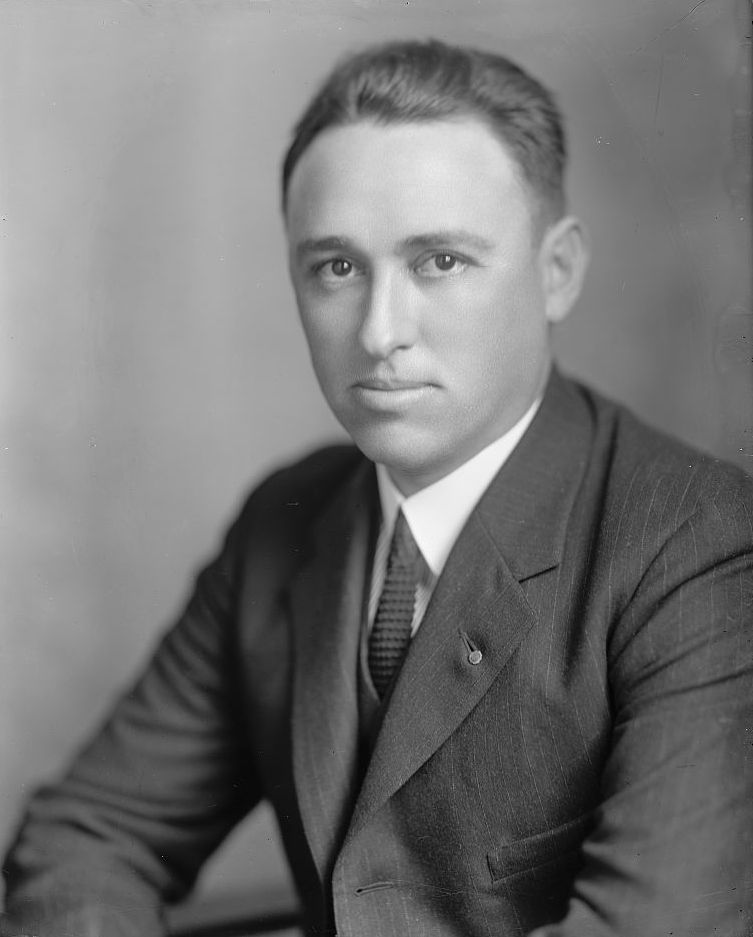
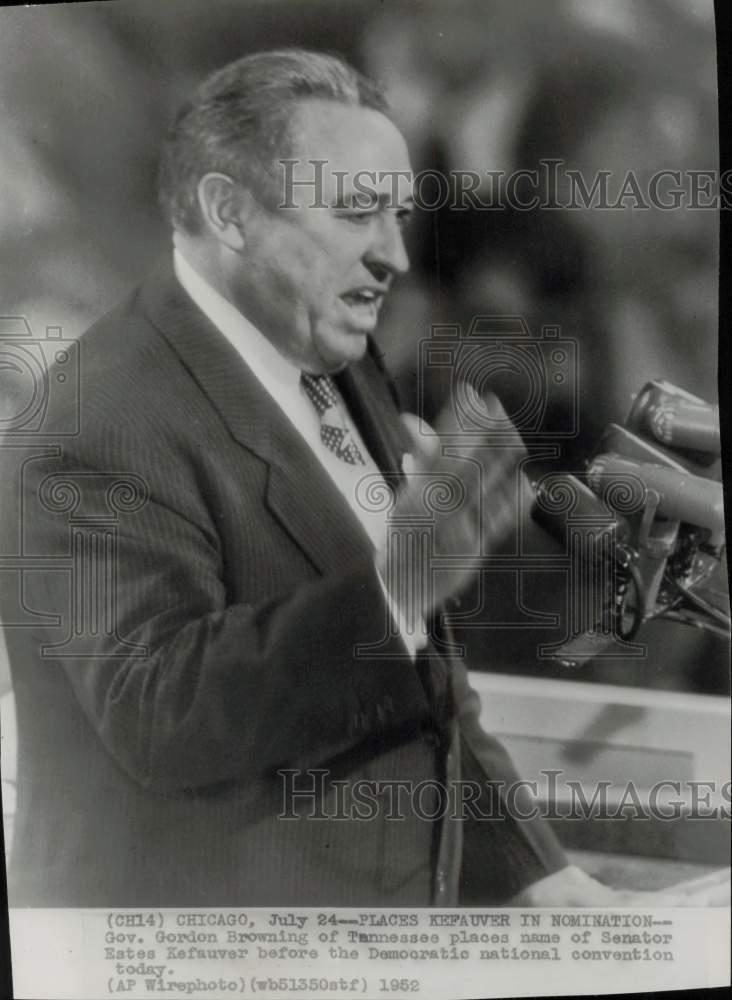
Gordon Weaver Browning was born in Carroll County near Atwood on November 22, 1889. He attended public schools until he began his college career. Gordon Browning received his B.S. at Valparaiso University in Indiana in 1913. He graduated from Cumberland University Law School in 1915. After being admitted to the bar, he began his law practice in Huntingdon, Tennessee.
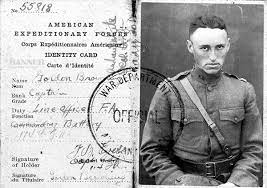
In 1917, Gordon Browning enlisted in the National Guard. While in the National Guard, he was promoted to First Lieutenant and Captain. Gordon Browning served in France during the first World War. In 1919, Gordon Browning was discharged from service and he then resumed his law practice in Huntingdon.
Gordon Browning served six terms in the United States House of Representatives from 1923 to 1935. Gordon Browning became the 38th governor of the State of Tennessee and served from 1937 to 1939.
On February 17, 1943, he was appointed captain in the United States Army and he advanced through the ranks to Lieutenant Colonel. During WWII, he acted as deputy head of the Belgium-Luxembourg missions until January of 1946.
From 1942-1949, Governor Browning served as the Chancellor of Tennessee’s Eighth Chancery District. Governor Browning again served another term as Governor of the State of Tennessee from 1949-1953.
While Governor of the State of Tennessee, Governor Browning had many achievements. He helped to bring Tennessee’s state debt down. He also established the first effective retirement system for teachers as well as establishing a minimum salary for teachers. The poll tax for women and veterans in the primary was abolished. This is but a few of the accomplishments.
Governor Browning has the distinction of serving in both World Wars. After retiring from his political career, Governor Browning returned to his law practice in Huntingdon, where he remained until his death in 1976. The City of McKenzie now has the Gordon Browning Museum where Governor Browning’s life is showcased.
For the video presentation of Governor Gordon Browning by local attorney Gus Radford, please go the following link:
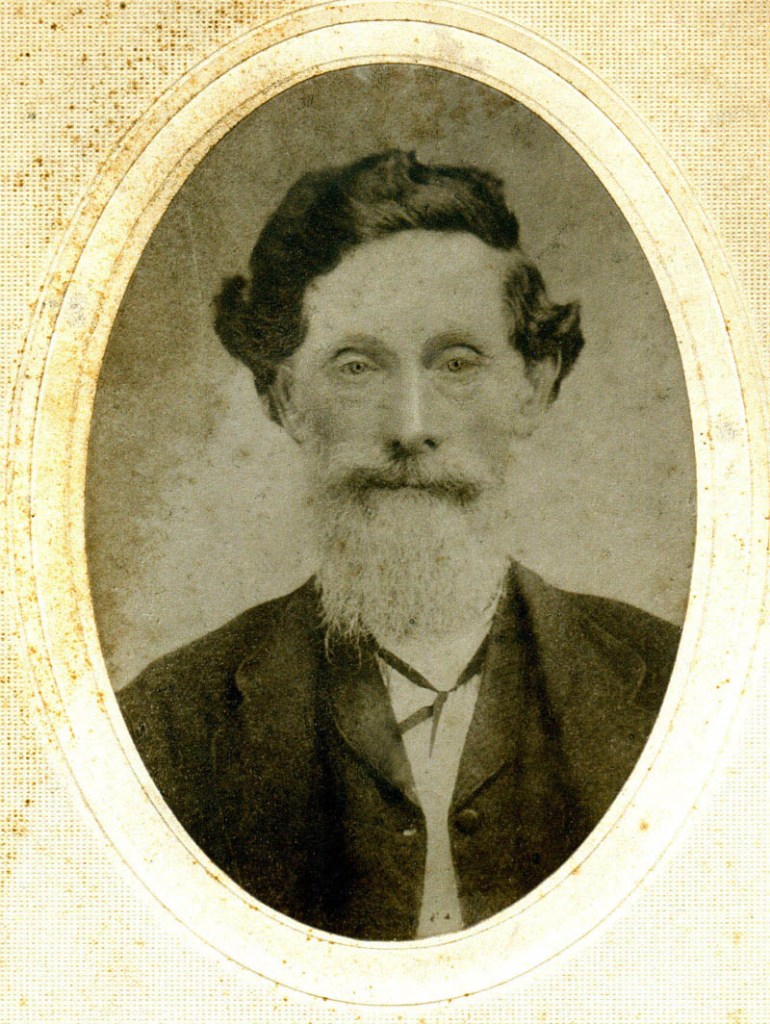
The area of McKenzie was originally inhabited by Chickasaw Indians. In 1865, the land was surveyed and platted on land that belonged to James Monroe McKenzie. The town of McKenzie was incorporated in 1869 and was known as McKenzie Station, as it was established at the intersection of two railroads: the Nashville and Northwestern Railroad and the Louisville and Memphis Railroad.
Above, James Monroe McKenzie.
It was in 1818 that Andrew Jackson and Isaac Shelby had negotiated a purchase of land from the Chickasaw Indian Nation. The land purchased was in Western Kentucky and Tennessee. The Tennessee portion became West Tennessee. This purchase promoted American settlements and expansion.
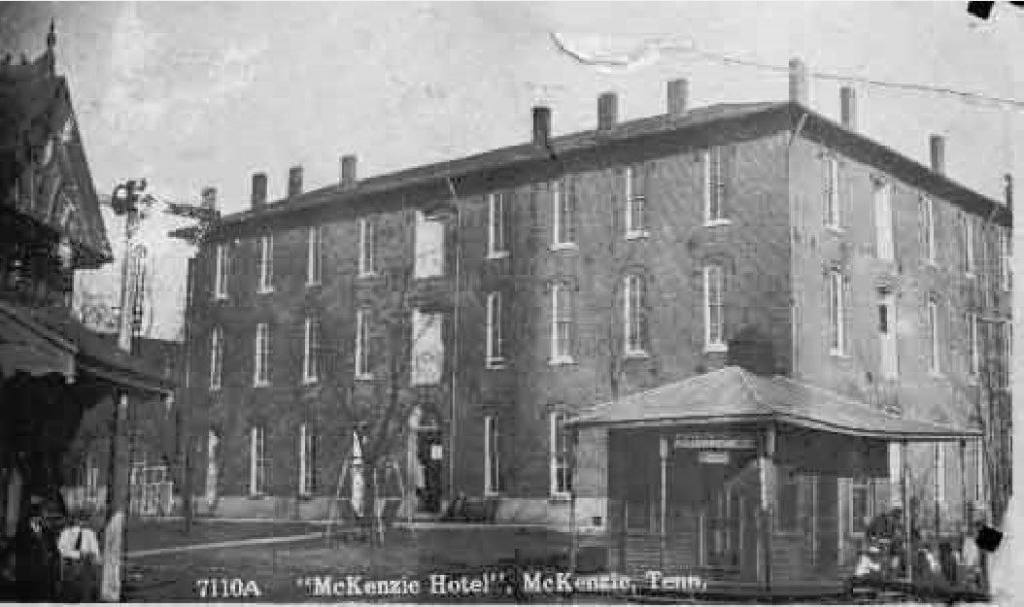
Carroll County was established in 1821. James Monroe McKenzie bought his 212 acres of land in 1837. McKenzie was incorporated in 1869. In 1887, Grover Cleveland visited the area while campaigning. Local lore is that he almost stayed overnight in the McKenzie Hotel, pictured below.
Many famous people have stopped in McKenzie, one of the most noteworthy was Elvis Presley. Elvis had stopped to eat at a local diner. Carl Perkins, another famous musician, also visited McKenzie.
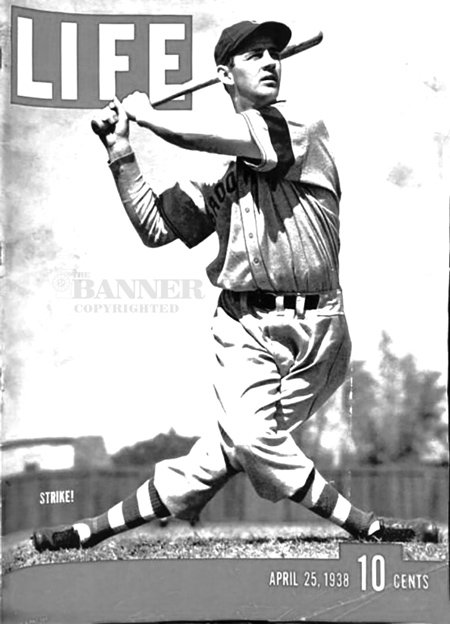
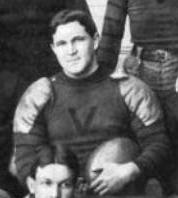
McKenzie has produced many creative and hardworking people. Two will be mentioned here: Tom Winsett, who was a baseball player and was pictured on Life Magazine in 1938; Harris T. Collier, who was a head coach at Tulane in 1899 and he was a head coach for Georgia Tech in 1900.
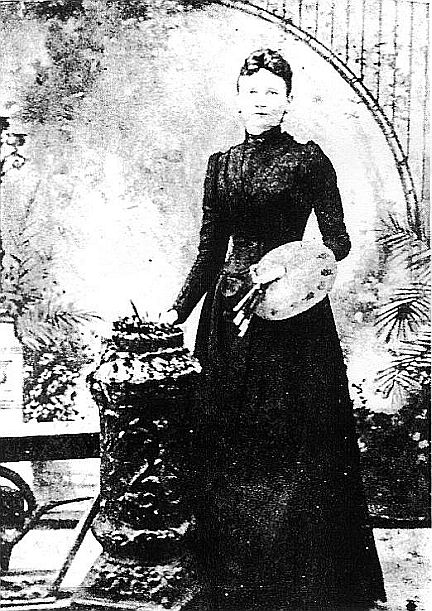
Annie Cole Hawkins, who lived in McKenzie during the Civil War, chronicled the everyday events in War Leaflets, which can be found on the internet.
Mr. Jack Holland did present the history of McKenzie to the Huntingdon TN Historical Society on July 16, 2025. A video of this presentation can be found at the Facebook page of the Huntingdon TN Historical Society.
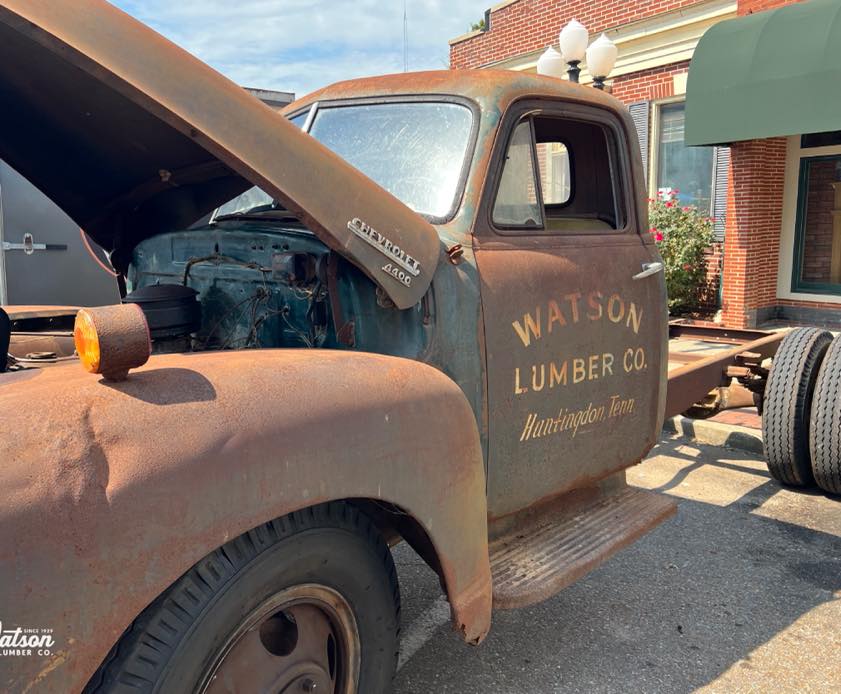
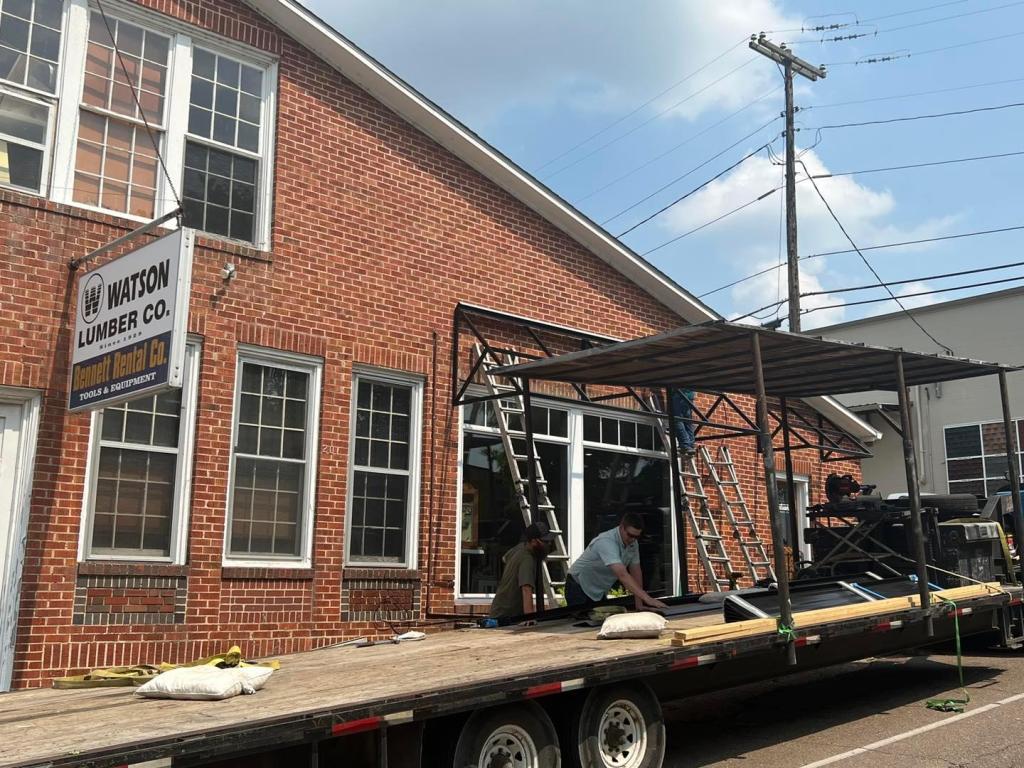
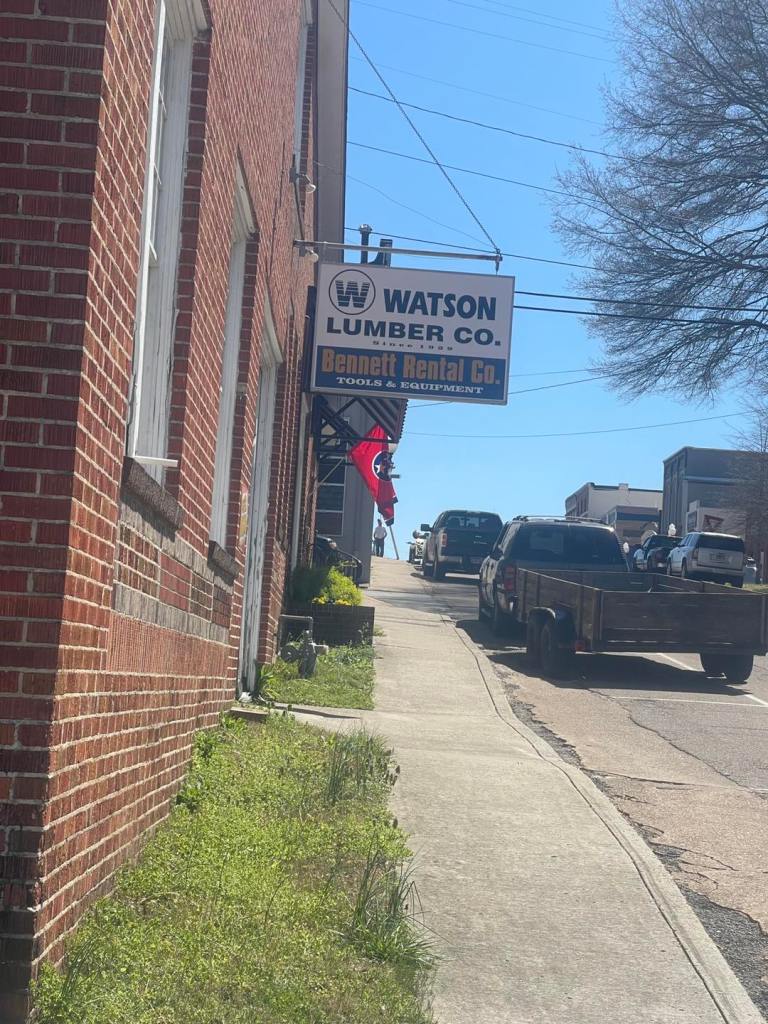
Watson Lumber Company was founded in 1929 by Tobe Watson. The site of the lumber company was 114 W. Paris Street in Huntingdon, Tennessee. It was conveniently located on the court square. Watson Lumber Company remains in business today and is also remains on the same site. Watson Lumber Company has been in business for 96 years.
Crocker Watson, Tobe Watson’s son, took over management of the company from Tobe Watson. Crocker Watson managed the business until his death in 1969, when James Crocker Watson, Jr took over management along with his mother, Kathryn Watson.
In the 1980’s, James Crocker Watson and his mother purchased the building next door to the lumber company and expanded the business to include what would become The Hardware House.
In 2013, the business was sold to Seth and Jill Bennett who continue to operate the business to this day. The business offers many services that include: building materials, plumbing and electrical materials, hardware and tools, as well as paint and paint supplies. They offer flooring and outside materials like fencing. They also make keys.
Seth Bennett, the current owner, did give a presentation of the history of the Watson Lumber Company to the Huntingdon TN Historical Society on August 21, 2024. The Huntingdon TN Historical Society presents a different speaker every month. The society meets every 3rd Wednesday of the month at 9:00 a.m.
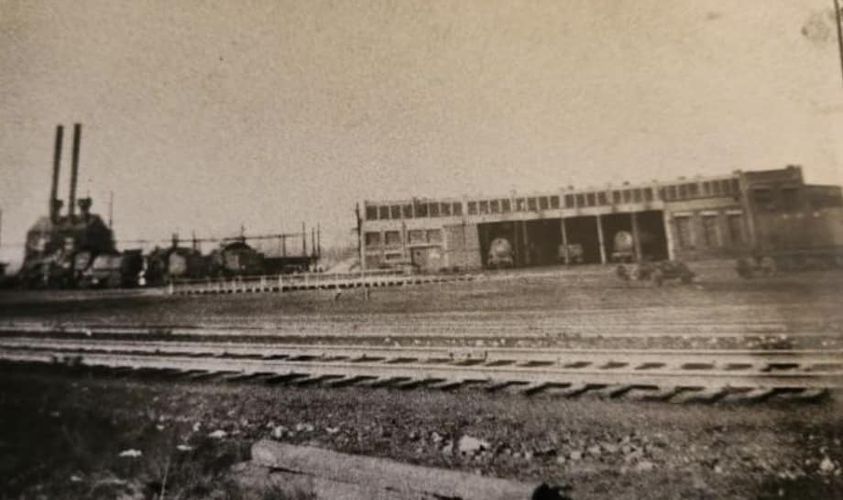
Above is a picture of the old roundhouse that is still located in Bruceton, Tennessee
A more recent picture of the same roundhouse.
On September 18, 2024, Mr. Buddy Smothers provided a presentation on the history of Bruceton, Hollow Rock, and the railroad that still runs through both towns. Buddy Smothers is a retired high school history teacher and he taught for 34 years. He was also a local radio sports personality for 34 years.
Buddy Smothers began his talk speaking about Alexis Tocqueville’s visit to the Bruceton and Hollow Rock area in 1831. Tocqueville and his traveling mate, Gustave de Beaumont, spent 4 days in an inn at Sandy Bridge, which later became Hollow Rock. Tocqueville was recovering from an illness at the time.
It was stated that McLemoresville and Buena Vista, two local areas, are the two oldest areas in Tennessee. Hollow Rock was incorporated in 1869.
The town of Hollow Rock was named for this rock formation in 1867, when a telegraph office and train station were established.
In the late 1800’s, the Nashville, Chattanooga, and St. Louis Railroad System operated in Hollow Rock. Hollow Rock was the only place where four lines of the railroad intersected with one another. In the 1890’s, the railroad moved their location and created the town of Junction City. Junction City later became Bruceton.
The Hollow Rock-Bruceton Special School District was formed in 1927. Prior to 1927, the only other high school in the area was in Hollow Rock. The Hollow Rock High School was in operation from 1914 to 1927.
Above is an older picture of the high school.
The railroad was integral to the development of the Bruceton and Hollow Rock area. Other businesses that have been important in the development of the local economy was H.I.S., which left the area in 2000. The railroad depot still remains in Bruceton today.
For a more in depth look at this presentation, see the Carroll County News-Leader, Wednesday September 25, 2024 by Jesse Joseph.
On Wednesday, May 21, 2025 Mr. Phil Williams was the speaker at the monthly meeting of the historical society. However, before Mr. Williams spoke, the group was introduced to a Mr. James Allen Gooch from the Rutherford County Historical Society. Mr. Gooch knew Mr. Williams through the Williams Furniture Store in McKenzie, Tennessee that Phil Williams owned and managed for 46 years before his retirement. James and Carol Gooch specialize in cemetery preservation and offered their knowledge to the group.
Phil Williams gave his talk on the history of McLemoresville, Tennessee, as well as on his father, Billy O. Williams, who was a Poet Laureate of Carroll County and an Associate Poet Laureate of the State of Tennessee.
Pictured above is Billy O. Williams. Billy Williams also served in the Air Force during WWII. During this presentation, Phil Williams read a poem that his father had written to the group.
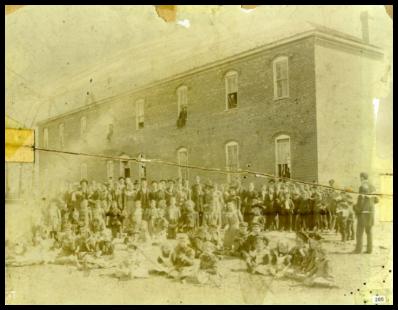
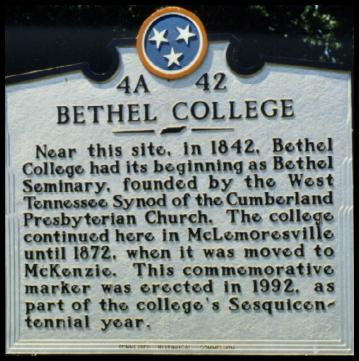
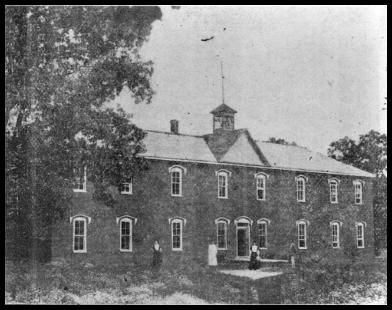
Above is a picture of the Old Main Campus Building of Bethel College. Bethel College began as Bethel Seminary and was founded by West Tennessee Synod of the Cumberland Presbyterian Church in 1842. The picture above was taken at approximately 1900 – 1905. The college was moved to McKenzie, TN in 1872.
This was a picture of the Main Campus Building that was town down in 1912.
Carrolton was established as a town on land that was owned by R.E.C. Dougherty, who was a surveyor and entry taker in 1819. The town later became McLemoresville.
The town of McLemoresville was named for Colonel John Christmas Mclemore, who owned much of the land in McLemoresville in 1820. The first county court was also in McLemoresville. It was called the court of pleas and quarter sessions and was organized in March of 1822.
Perhaps the most famous resident of McLemoresville, TN is Dixie Carter, who was born in McLemoresville, Tn in 1939. Her father owned and operated a dry goods store in McLemoresville. Dixie Carter is also buried in McLemoresville.
There is a link at the top of the page to the video on the presentation by Phil Williams of the history of McLemoresville, Tn.
Carl Mann was a singer, artist, and cultural icon who is from Carroll County, Tennessee. Carl Mann was born on August 22, 1942 in Huntingdon, Tennessee. As a child, Carl Mann sang in the church and also participated in local talent shows where he sang country songs in those talent shows. Carl Mann played the guitar and the piano. In 1957, Carl Mann released his first single entitled “Gonna Rock and Roll Tonight” on the Jaxon Records label.
Bill Holland, who was Carl Mann’s drummer, later became Carl Mann’s manager. Under Bill Holland’s management, Carl Mann was signed to Sun Records. Soon after, Mann released a rockabilly version of Nat King Cole’s “Mona Lisa”. Carl Mann was sixteen at the time and the song charted and peaked at #24 on the US Black Singles chart and #25 on the Billboard Hot 100 in 1959.
Carl Mann also had another single released in 1959. It was “Pretend” and it peaked at #57. Carl Mann released an LP in 1960. He served in the Army in 1964. Afterwards, he released a single, “Down To My Last I Love You” on Monument records.
In 1974, Mann returned as a country artist and his 1976 song “Twilight Time” peaked at #100 on the US Country Singles chart. In 1978, he released a live/studio split called “Gonna Rock’n’Roll Tonight”. In 1981, he released “In Rockabilly Country”. In the 1980’s, Carl Mann toured Europe.
Carl Mann died on December 16, 2020 and was interred at Palmer Shelter Cemetery.
On June 18,2025 Mr. Lex Suite, Principal at Riverside High School, gave a presentation on Carl Mann to the Huntingdon TN Historical Society. You can see a video of this presentation at:
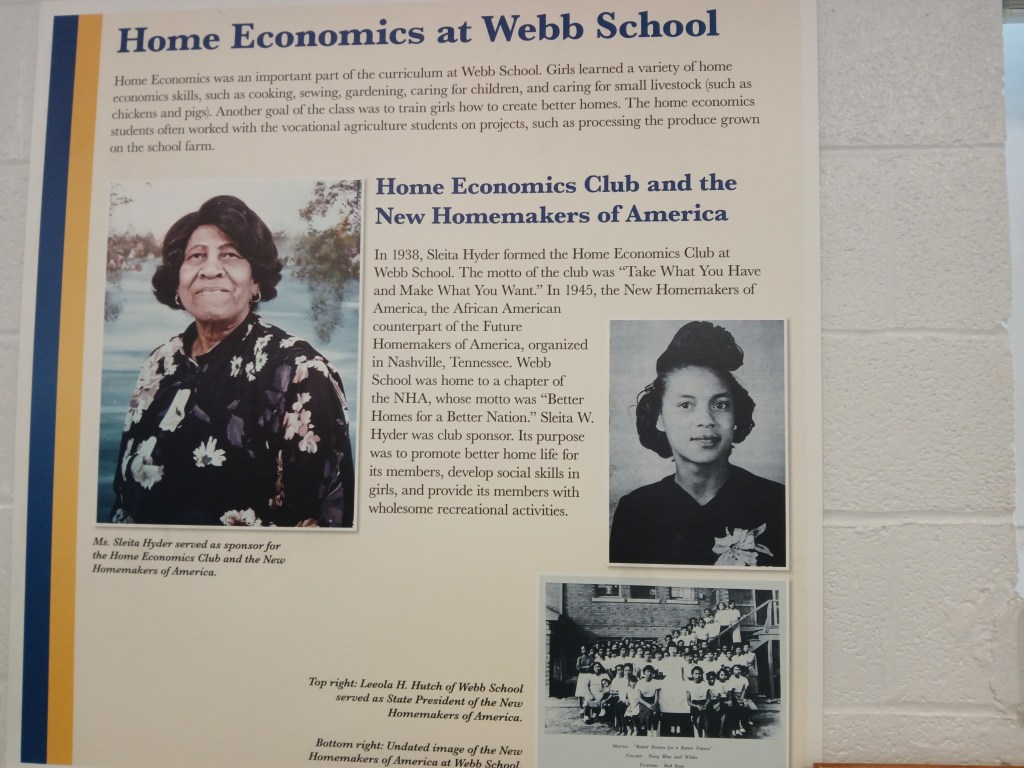
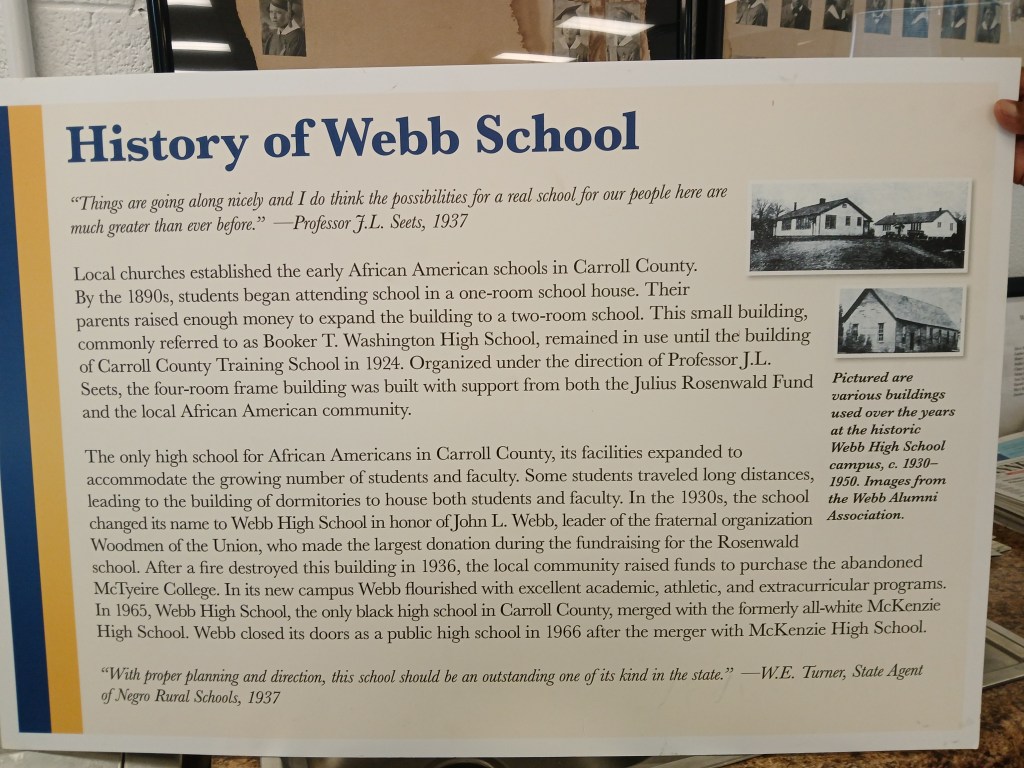
On Wednesday, October 16, 2024 in the conference room of City Hall in Huntingdon, Mr. Ike Gilbert was our narrator. Ike Gilbert is the current President of the Webb School Alumni Association. The Webb School Alumni Association began in 1971. The purpose of the association was to found Webb School Historical Museum and preserve the legacy of the school and alumni. The museum opened on September 2, 2016. Included in the museum are different exhibits, interpretive panels, class pictures, and school artifacts. The Museum is located at 938 Walnut Street, Mckenzie, TN 38201. The museum is open to the public on Tuesdays and Saturdays from 11:00 to 3:00 p.m.
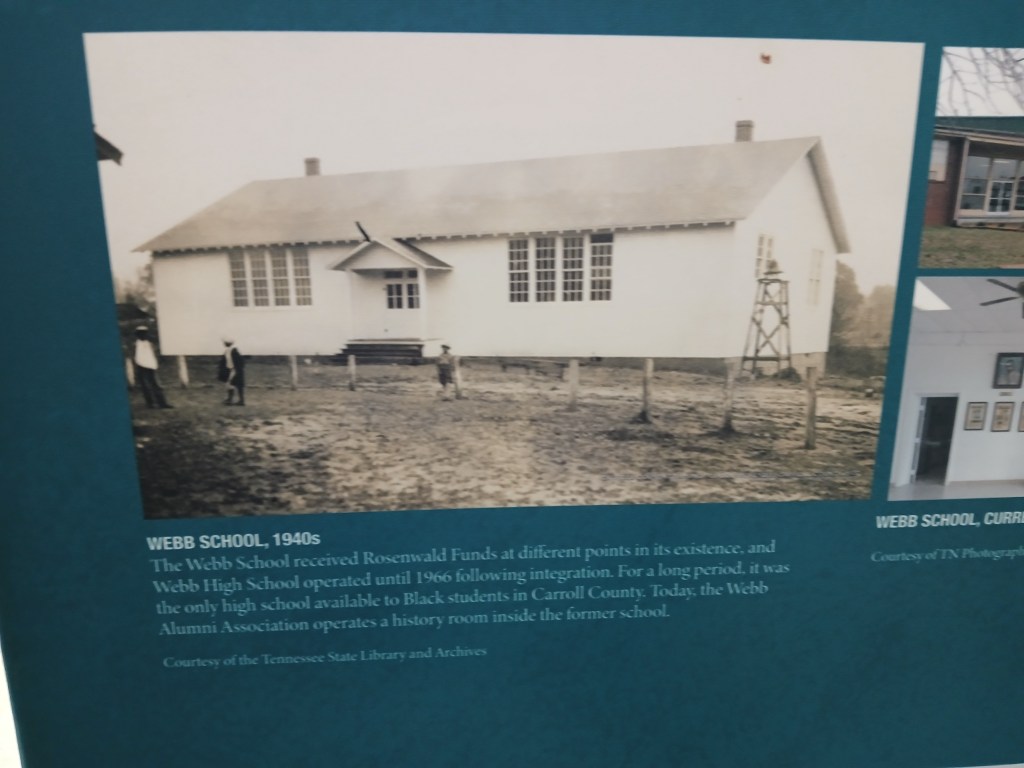
The plans for Webb School were begun in 1912. The Julius Rosenwald Fund, which provided matching funds for local school systems to build schools for African American communities, helped to build twelve schools in Carroll County alone. More than 350 schools were built in the State of Tennessee.
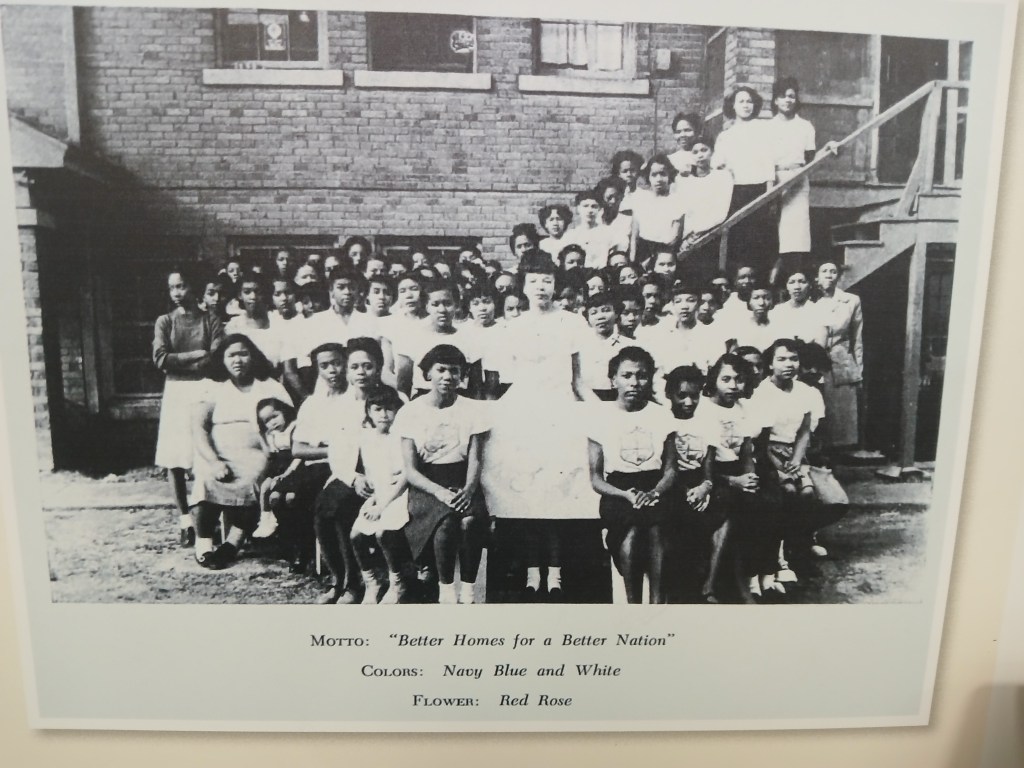
The first graduating class for Webb School was in 1932, with a total of two graduates at the time. In 1966, the last graduating class of Webb School, there were 32 graduates. Over the course of the life of the school, over 1900 young men and women graduated from Webb School. Besides having sports clubs, glee clubs, choral clubs, and home economics clubs, Webb School also provided music education. Alfred Harrell, also known as Chicago Pete, was one of the alumnus of Webb School. He was known as a bluesman and gospel singer.
After a fire destroyed the first Webb School, the school was moved to Mckenzie in its’ present location. Webb School has been placed on the National Register of Historic Places. You can watch the video of Mr. Ike Gilbert giving the presentation on Webb School at:
Pictured above are on the left, Neal Williamson, who is the former President of the Webb School Alumni Association. On the right is Michael Tate, current President of the Webb School Alumni Association. Between them is a billboard at the Webb School Museum which includes pictures of the Webb School in the 1940s and then a picture of the most recent Webb School.
On April 16,2025, Mrs. Linda Allen was the Storyteller for the Huntingdon TN Historical Society. Mrs. Allen spoke about the H.I.S. Company, which was located in Bruceton, Tennessee and also Sam Siegel, who was the Senior Vice President of H.I.S. Mrs. Linda Allen grew up in the town of Bruceton and many of her relatives worked for the H.I.S. company.
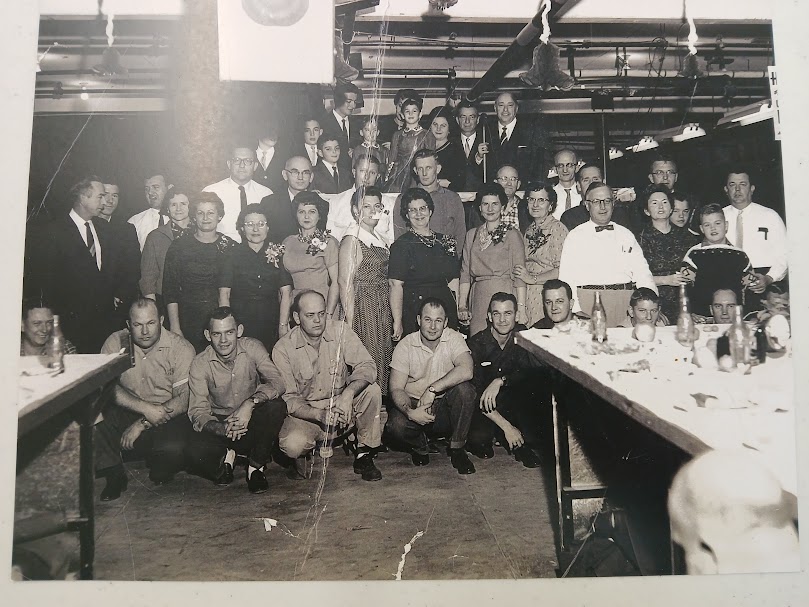
Mrs. Allen’s father is pictured with other workers in the picture above. This picture was taken approximately 1960 during a Christmas party.
Henry Siegel came to America from Lublin, Poland in the early 1900s. He began the company as Honesdale Manufacturing in 1923. The company headquarters were located in New York City. Honesdale Manufacturing specialized in men and boys clothing. There was one factory in Scranton, Pennsylvania and also a plant located in Germany.
In 1935 due to the persecution experienced in Europe, Sam Siegel, Henry’s brother, came to America. (The Siegel family did lose family members during WWII.) In 1936, Sam Siegel was sent to Dickson, Tennessee to the H.I.S. factory that was located there. The Dickson plant had been started in 1932. Sam then was sent to Bruceton, Tennessee where a new factory was being built. In 1939, trainees from Bruceton were being sent weekly to Dickson, Tennessee to be trained. The trainees boarded a train on Sunday evening to go to Dickson. They would spend the week in Dickson, and then on Friday afternoon at 4:00 p.m., the trainees would return to Bruceton via train. Bruceton was a railroad town and therefore had daily access to a train.
Prior to the factory being completed in 1940 in Bruceton, sewing machine workers worked in an old church building located in Bruceton on Highway 70. That old church building still stands today and can be seen as you pass through the town of Bruceton. Fifty people worked in that old church building.
In 1940, wages were 40 cents an hour. During WWII, as many as 1,000 employees worked at the factory. H.I.S. made military clothing, as well as other clothing. In 1949, Henry Siegel died unexpectedly and his son, Jesse, took over the company.
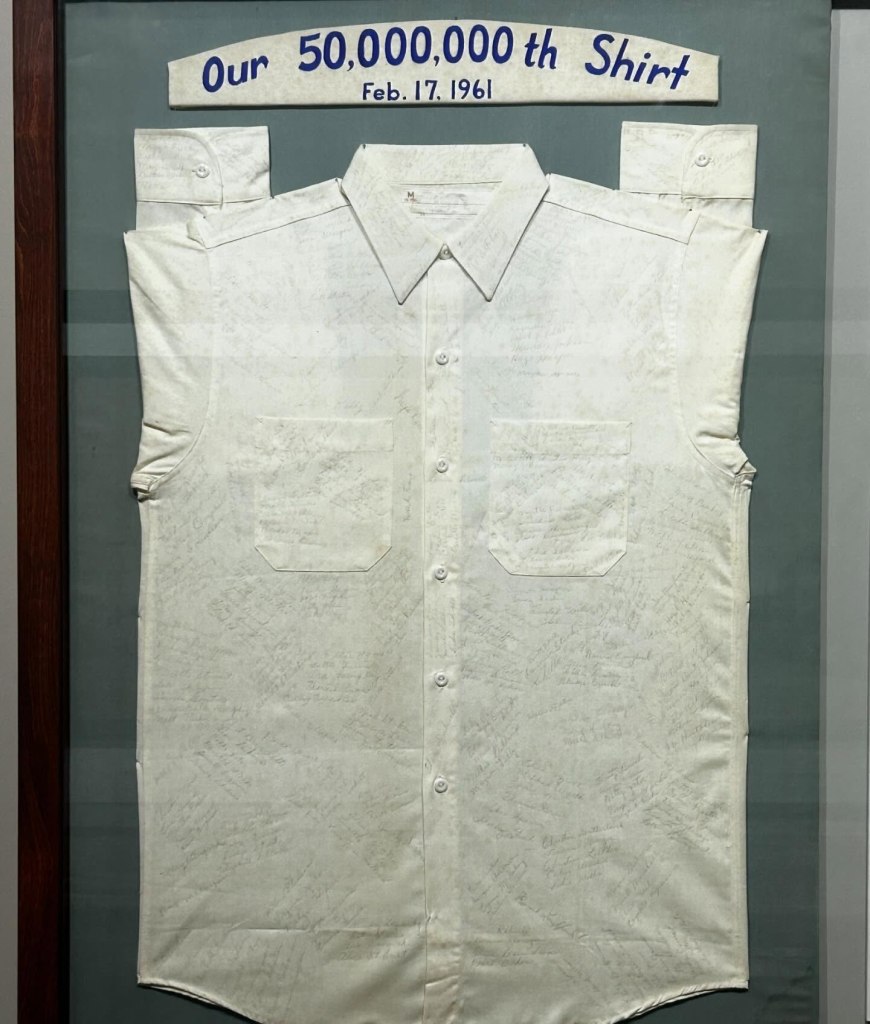
In 1961, the fifty millionth shirt was completed in Dickson, Tennessee. That shirt is pictured above
H.I.S. began making women’s clothing in 1964. By the mid 1980’s, H.I.S. was the third largest maker of women’s clothing. In the 1970’s, imported clothing into the United States began to hurt the H.I.S. business. Then NAFTA was implemented in 1994 and many companies began to move to Mexico. This greatly hurt manufacturing in the United States. It is estimated that between 4.5 million jobs and 8.9 million jobs were lost in the United States due to NAFTA. The Bruceton H.I.S. plant closed in 2000. Where once the H.I.S. Outlet stood, now there is a Dollar Tree/Family Dollar store.
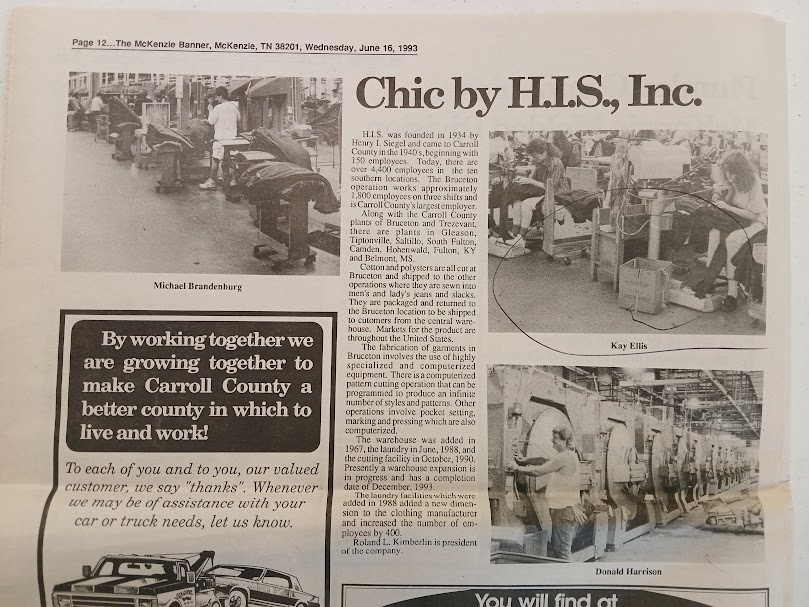
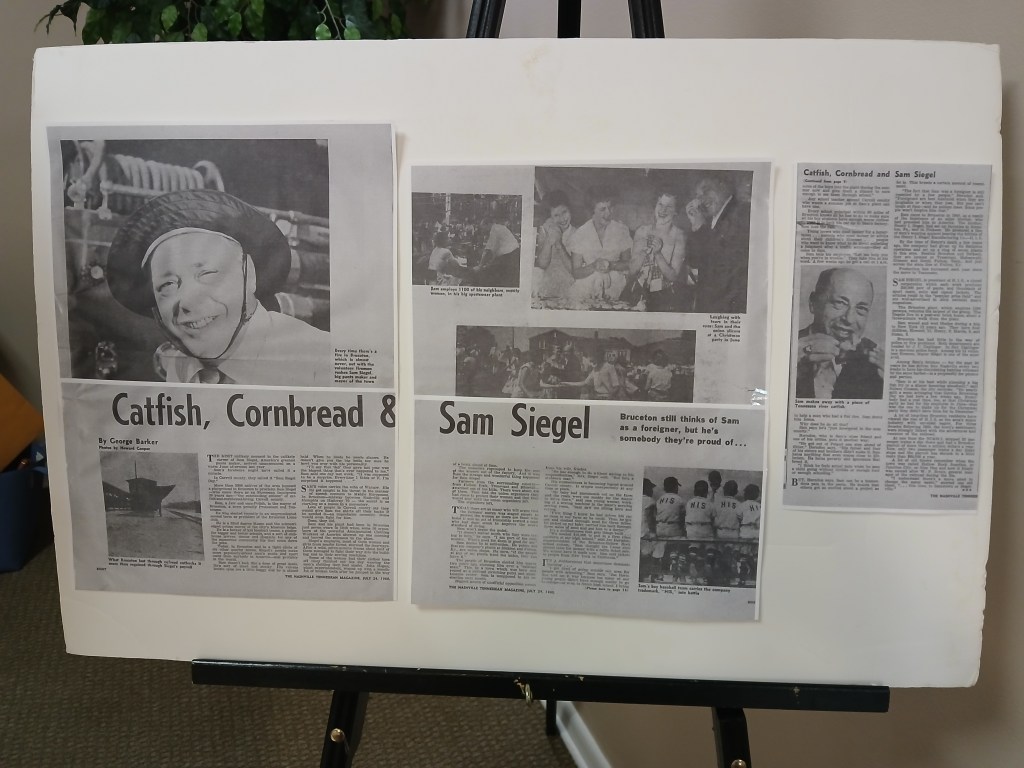
Pictured above is an article regarding Sam Siegel. Besides many other ventures, Sam Siegel also helped out the Volunteer Fire Department in Bruceton.
Sam Siegel was born in 1909 in Poland. He came to America in 1935, was sent to the Scranton, Pennsylvania plan, and then in 1936 was sent to the plant in Dickson, Tennessee. Following plans to build a plant in Bruceton, TN, Sam and his family moved to Bruceton. The plant was completed in Bruceton in 1940. Prior to that, sewing machine workers worked in an old church building located on Highway 70.
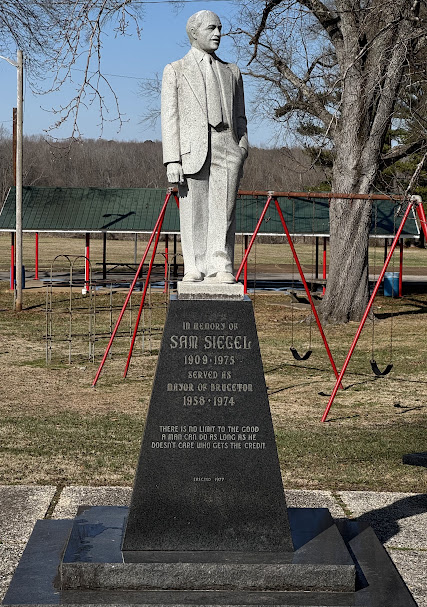
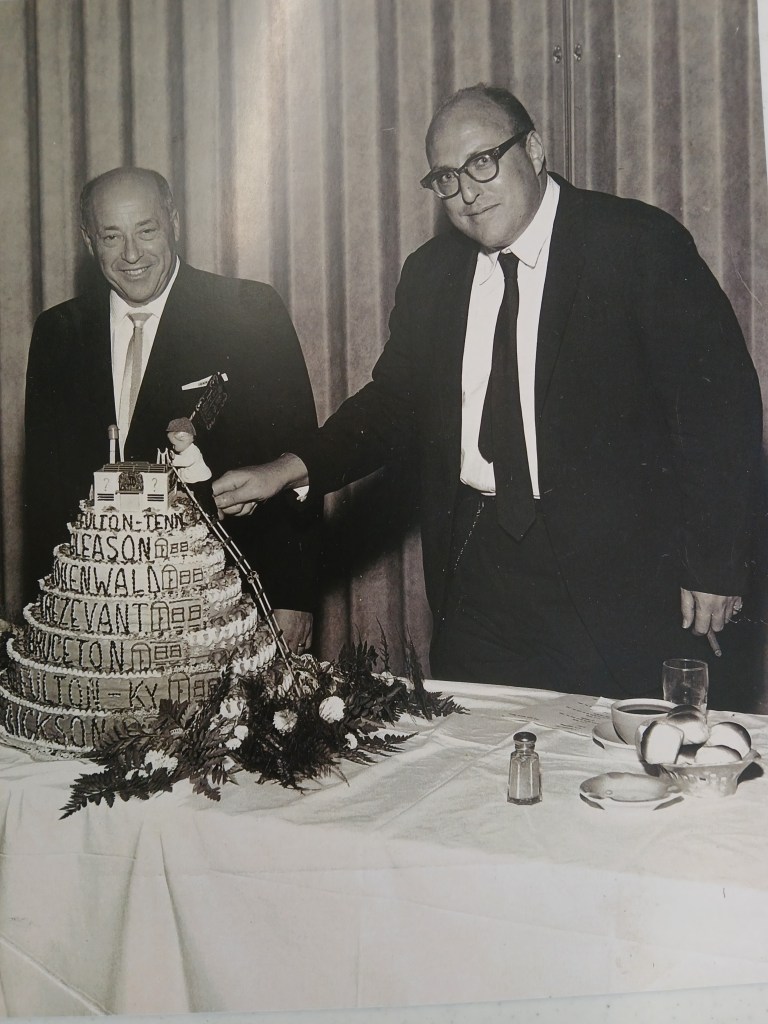
Sam Siegel became mayor of Bruceton in 1958 and was mayor of Bruceton until 1974. He died in May of 1975.
By people who lived and worked with him, Sam Siegel was known as a charitable person. He gave jobs to teenagers and others who needed jobs. Linda Allen stated that Sam Siegel and H.I.S. had been very good to her family. There are many others who felt the same way.
The Huntingdon TN Historical Society would like to thank Mrs. Linda Allen for her presentation. There is a video of Mrs. Allen’s presentation on the Huntingdon TN Historical Society facebook page. The URL is at the top of this article.
The Huntingdon TN Historical Society meets every third Wednesday of the month at 9:00 a.m. in the conference room of City Hall in Huntingdon, Tennessee.
On November 20, 2024 Judge Donald Parish spoke at the Huntingdon TN Historical Society. His program revolved around three prominent Tennesseans from the past: Justice Howell Edmunds Jackson, Attorney Milton Brown, and Judge John Ethridge McCall.
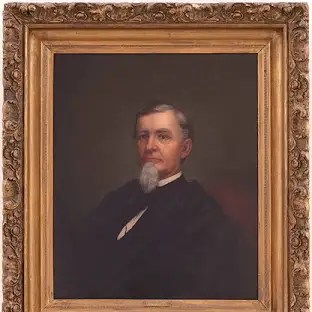
Justice Howell Edmunds Jackson was born April 8, 1832 in Paris, Tennessee, was the son of a wealthy family. In 1840, the family moved to Jackson, Tennessee. He graduated from West Tennessee College in 1849. He then attended the University of Virginia at Charlottesville and graduated in 1854. Justice Jackson then studied law at Cumberland University in Lebanon Tennessee. He graduated in 1856. Judge Jackson was admitted to the bar and began practicing law in Jackson, Tennessee. Judge Jackson then moved to Memphis, Tennessee.
During the Civil War, Judge Jackson was pro-slavery and was opposed to succession. While in the Confederacy, Judge Jackson was a receiver of sequestered property. In 1862, the Union Soldiers ran the Confederates out of the government in West Tennessee. Following the Civil War, Judge Jackson was charged with treason. He was pardoned by President Johnson and was allowed to practice law again.
In 1874, Judge Jackson returned to Jackson and served on the court of arbitration for West Tennessee by appointment on two occasions. In 1880, Judge Jackson was elected as State Representative. He then was elected to the United States Senate and served from March 4, 1881 to April 14, 1886.
Judge Jackson resigned from the Senate because he had been offered and he had accepted the appointment of United States Circuit Judge for the sixth Federal Circuit. Due to the death of Lucius Q. C. Lamar, a vacancy became available on the United States Supreme Court. Judge Jackson was appointed by the President and was confirmed by the Senate to that open position on the Supreme Court. Judge Jackson served on the Supreme Court from March 4, 1893 to August 8, 1895, when Judge Jackson died. Judge Jackson died in West Meade, Tennessee.
Two interesting facts about Judge Jackson: First, while on the Supreme Court, a question regarding the income tax was raised before the Supreme Court. The income tax was held to be unconstitutional by the court, however, Judge Jackson had sided with the government on this decision. Secondly, Judge Jackson was the only Supreme Court Justice to license his image to the cigar company. Do you recognize him?
M
Milton Brown, pictured above, was born in 1804 in Ohio. He migrated to Nashville in 1823, where he studied law in the office of Felix Grundy. After being admitted to the bar, Milton Brown practiced law in Paris, Tennessee. In 1832, Milton Brown moved to Jackson, Tennessee where he became actively involved in the community.
In 1834, the notorious criminal John Murrell had been apprehended and charged with theft and murder. A list of the many crimes that John Murrell committed included counterfeiting, horse theft, and slave stealing, all considered to be very serious crimes in the pre-civil war south. John Murrell was so notorious and disliked at this time, that no one wanted to represent John Murrell. It was then that Judge Joshua Haskell appointed Milton Brown to defend John Murrell.
Milton Brown’s strategy was to concede to the theft, but defend as to the murder charges. Milton Brown’s oratory and defense skills were so good, that John Murrell was found not guilty of murder and guilty of theft. As a result, John Murrell spent ten years in prison.
Milton Brown was appointed Chancellor of West Tennessee in 1837 and in 1839 he ran as the Whig nominee for the United States House of Representatives, which position he won. In 1845, Milton Brown was responsible for the deadlocked breaking resolution which allowed Texas into the Union.
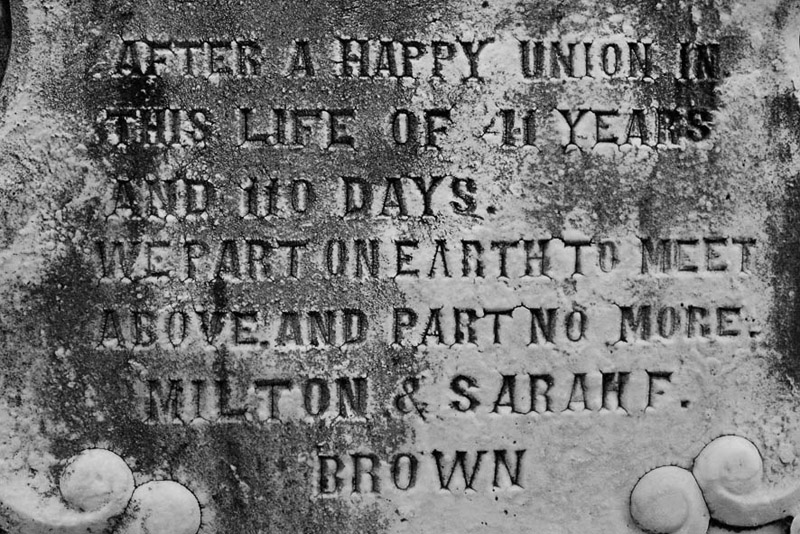
Later in life, Milton Brown became president of the Mississippi Central and Tennesee railroads from 1854-1856. He was then president of the Mobile and Ohio railroads from 1856-1871. Milton Brown was a charitable person and was instrumental in the founding of Union, Lambuth, and Vanderbilt universities. Milton Brown died in 1883 and was laid to rest in Jackson’s Riverside Cemetery.
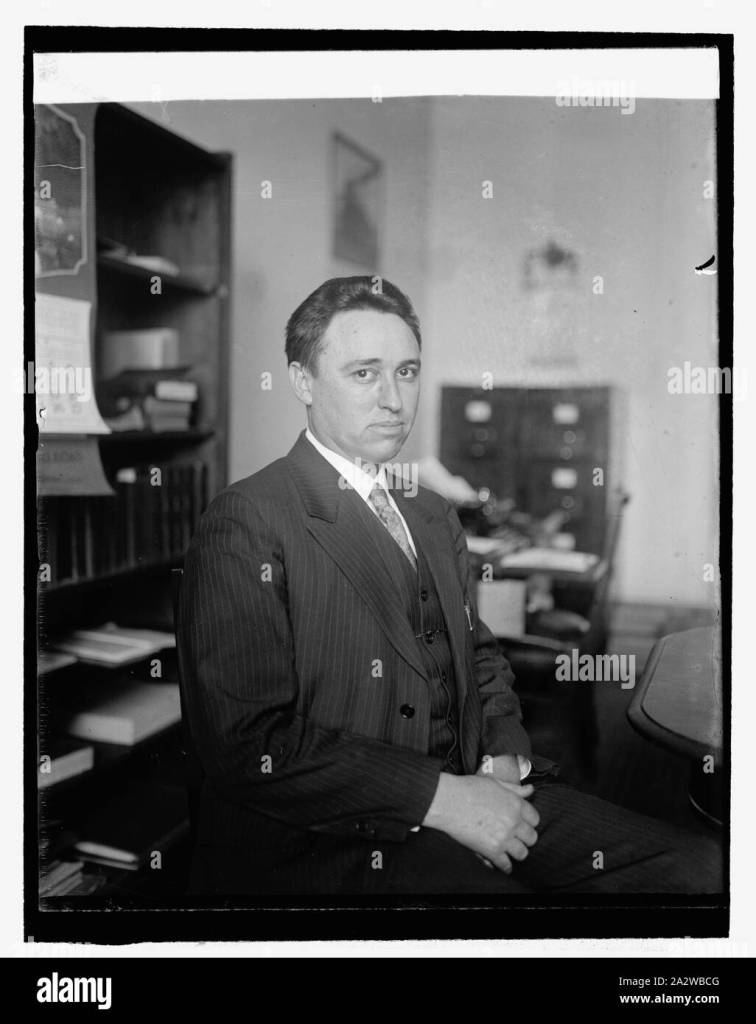
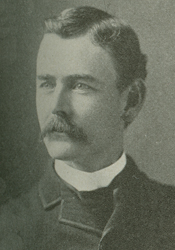
John Ethridge McCall, pictured above, was born in 1859 in Clarksburg, Tennessee. He graduated from the University of Tennessee at Knoxville in 1881. He then studied law in Huntingdon, Tennesee. He was admitted to the bar in 1882 and began his practice of law in Huntingdon, TN. Also, in 1882, he became the editor of the Tennessee Republican. He became a member of the State house of representatives from 1887-1889. He was appointed assistant United States district attorney for West Tennessee in 1890. He was elected as a Republican to the Fifty-fourth Congress and served from March 4, 1895 – March 3, 1897. He was a candidate for Governor of the State of Tennessee in 1900. From 1902 – 1905, John McCall was a collector for the Internal Revenue Service. On January 17, 1905, he was appointed by the President of the United States to United States District Judge for the western district of the State of Tennessee. Judge McCall remained on the district court until his death on August 8, 1920. He was laid to rest at Forest Hill Cemetery in Memphis, Tennessee.
While most of the information gleamed for this article came from the Honorable Judge Donald Parish, this writer also needs to acknowledge information also came from TBA Law Blog in an article written by Russell Fowler, the Tennessee Encyclopedia in an article written by Russell Fowler, and information was gleamed from History, Art, and Archives United States House of Representatives.
The Huntingdon TN Historical Society has a Facebook page where there is a video of Donald Parish presenting this history. Please come and join us in learning and sharing the history of Carroll County and of the State of Tennesse.








 The History of Carroll County, Tennessee